Note from the Blogger

These mini-reviews are intended to be short recommendations, not full blown literary reviews. Please feel free to add your own comments. -- Tim Drake

Thursday, August 27, 2020

The Edible Woman (1969) By Margaret Atwood


The Edible Woman was Margaret Atwood’s first book.  Published in 1969 it has been categorized as belonging in almost every literary genre one can list. For me, I’ll call it feminist, though from reading interviews of Atwood I’m not sure she would completely agree.

The lead character is a young woman living in Toronto.  Her name is Marian.  She works for a marketing firm writing survey questionnaires.    

Marian is single.  Early in the book she will become engaged to her boyfriend Peter because that is the expected next step in her life.  Peter is what would have been called at the time “a good catch,” a handsome, up-and-coming professional. He, without a clue, treats her as nothing more than an accessory in his professional advancement. Peter though clearly a schmuck, is not necessarily an evil one. Her realization of this is the main plot of the book.

Ainsley is Marian’s roommate.  They have little in common.  Marian’s character is buying into what is supposed to be “a woman’s role” in society. Ainsley is having none of that.  Ainsley’s subplot is her decision to have a baby, without a husband.  She picks out an old friend of Marian’s to be the father, then waits until her pregnancy is confirmed before telling him his role is complete; he is no longer needed.

Then there is Duncan, without competition the most bizarre character in the story.  For most of the book he is referred to as “the laundromat guy.”  From scene to scene he is either a very insecure geek, or a complete jerk … sometimes both.  Duncan, and his two roommates, are English Literature Masters students – and Atwood’s depiction of the trio is priceless, not to mention spot on.  Through Duncan, Marian will realize she needs to bail from her “a woman’s role” trajectory.

Throughout the story, Marion develops increasingly severe eating disorders, all stress related.  How she deals with these is the source of the book’s title and makes for a hilarious conclusion.

Recommendation:  Highly recommended


Wednesday, July 29, 2020

Cat's Cradle (1963) By Kurt Vonnegut

Chicago Tribune photo

Kurt Vonnegut's fourth novel was Cat's Cradle, written in 1963. It is perfectly bizarre, I loved it. As bizarre is that I didn't read Cat's Cradle until this week. I was aware of it back in my high school days, I just never read it -- probably because it wasn't required reading (unlike Slaughterhouse-Five). My loss.

The novel is a combination of pure sarcasm, science fiction, biting political commentary, and equally biting "comparative religion," with a touch of Mad Magazine thrown in to hold it all together.

The story's narrator is Jonah, a free-lance writer. He's working on what he hopes will become the book that will make him famous, about what important Americans were doing on the day the first atomic bomb was dropped, on Hiroshima, Japan. He will title it: The Day the World Ended.

On his list of people he hopes to write about is (the fictional) Dr. Felix Hoenniker, who in the book is the "father of the atomic bomb." He's a poorly paid scientist subcontracted by the Department of War.  Hoenniker however is deceased, so Jonah sought to interview his three children as to what their father was doing on the day the bomb was dropped.  Was he apprehensive, guilt ridden, or did he celebrate what would end World War II, and his role in it?

Jonah was able to interview two of the three children. Newt a "midget" who is the youngest child; and his sister Angela, who largely took care of the family after the death of their mother. Missing was the oldest son Frank who disappeared after his father's death, and is presumed murdered. Jonah does however uncover that Dr. Hoenniker was working on another secret invention, called ice-nine, at the time of his death, but appears to have taken its details to the grave with him.

After giving up on the book for awhile, Jonah receives an assignment to write a magazine piece about San Lorenzo, "the barracuda capital of the world" located somewhere in the Caribbean.  On his flight to the island-country, he discovers that Angela and Newt are also onboard, on their way to brother Frank's wedding.

Through an endless series of hysterical circumstances, Jonah will discover the secret of ice-nine, and garner first-person documentation for The Day the World really Ended.
    
Recommendation:  Yes, completely fun.

Sunday, July 19, 2020

The Hound of the Baskervilles (1902) By Sir Arthur Conan Doyle


Last week, to take my mind off of current events (pick your news nightmare), I re-read Sir Arthur Conan Doyle’s The Hound of the Baskervilles, one of the best known of the Sherlock Holmes stories. Published in 1902, and at just 249 pages, the cultural shelf life of this book is beyond phenomenal. 

The case to be solved in this book is to uncover the true story behind a "supernatural" hound that has become the curse of the Baskervilles, an artistocratic British family with a hereditary estate – Sir Charles Baskerville has died mysteriously, and the new heir is Sir Henry Baskerville, who had been living in Canada.  The estate, Baskerville Hall, is quite remote, in the moors of the west country.

Sir Arthur Conan Doyle’s output of Sherlock Holmes novels (4) and short stories (56) is impressive enough, but the Sherlock Holmes franchise, now in its second century, also includes countless republications in countless languages, audiobooks, radio programs, theater productions, television shows, and an exhaustive list of movie adaptions – and still growing, having lost none of its popularity. The books are now in the public domain, so there will be more.  When I finished reading the book, I watched the 1983 movie version on Amazon Prime starring Ian Richardson and Donald Churchill which was well done. I'm also a fan of the Sherlock Holmes series on Netflix.

Sherlock Holmes and Dr. Watson are two of the world’s best-known fictional characters – along with the likes of David Copperfield and Huck Finn.  There is a reason for that, people, including me, like them.

Recommendation:  Yes, fun and relaxing.  

Tuesday, July 14, 2020

God Bless You, Mr. Rosewater (1965) By Kurt Vonnegut Jr.


Kurt Vonnegut was one of the “cutting edge” authors of my teen years, and beyond. His novel Slaughterhouse-Five was literally required reading. However, I was never that into his writings – my reading interests back then were almost exclusively nonfiction. This year, I’ve been revisiting some of his many other works: Galapagos during my winter vacation; and now God Bless You, Mr. Rosewater.

This novel is set largely in fictional Rosewater County in Indiana – for the record, Vonnegut was raised in Indianapolis. Generations ago the Rosewater family settled the county and built and grew their business, (a sawmill and other profitable businesses) making them exceedingly rich, and easily the most prominent citizens in town. Their status in the Hoosier state was not unlike the (real life) Ball family of Ball Industries (glass jars for food canning) in Muncie where Ball State University is located, or even the fictional Magnificent Ambersons, portrayed in Booth Tarkington’s classic also set in Indianapolis.  

The Rosewater accumulated fortune went into a charitable foundation, control of which has been passed on to Eliot, the grandson of the company’s founder.  How proper control of the Foundation is viewed is the subject of the novel. Does one have buildings named after the Rosewaters? Does one bankroll important philanthropic causes? Does one buy fire trucks? Does one just give money away?

The plot details an attempt to wrestle control of the Foundation away from Eliot by having him declared mentally incompetent.  The novel is deeply and deliciously cynical, with a just and quite funny ending. 

Recommendation:  Yes, definitely a thought-provoking book, particularly for those of us who spent our careers working in nonprofit organizations.

Wednesday, July 1, 2020

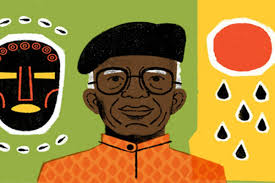
Things Fall Apart (1958) By Chinua Achebe


Heinemann Publishing founded the African Writers Series in 1962 to facilitate bringing an international audience to African authors.  The first novel they selected to print was Things Fall Apart by Chinua Achebe a Nigerian who wrote in English. It is the first book of his African Trilogy, which collectively tells of the impact of European colonization on the Africa continent. The other two are No Longer at Ease (1960), and Arrow of God (1964).  Achebe was presented with the Man Booker International Prize in 2007 for his lifetime of achievement.  He passed away in 2013.

Achebe opens his novel with an overview of village life, its family hierarchy, its belief structure with multiple Earth gods, and customs – seen through the eyes of Okonkwo, a leading Igbo warrior and farmer.  Some of the customs may seem barbaric today, but they worked successfully as a societal structure for generations.  When the Christian missionaries arrive (the “advance team” of colonization), things slowly, then quickly, begin to change, or as the book title put it, “things fall apart”. 

The novel is a remarkable piece of history-based fiction. I will read the other two books in the Trilogy.  The theme of Things Fall Apart parallels closely with a memorable book set in Tasmania that I read and blogged about several years ago: Doctor Wooreddy’s Prescription for Enduring the Ending of the World, by Mudrooroo.

I’ve read only a few books by African authors, including Season of Migration to the North by Tayeb Salih (Sudan) written in Arabic; Palace Walk by Naguib Mahfouz (Egypt) also written in Arabic; and A Palace in the Old VillageLeaving TangierThe Last Friend, all by Tahar Ben Jelloun (Morocco) written in French. Dalene Matthee’s Fiela’s Child (South Africa) is on my summer reading list. As you can see, I've read next to nothing by sub-Sahara authors. Recommendations of other African authors will be appreciated.  

Here is the list of books published in the African Writers Series.


Recommendation:  Definitely.

Tuesday, June 23, 2020

At the Mountains of Madness (1931)By H.P. Lovecraft


Occasionally I pick up a book to read for purely escapist reasons. These are often adventure books such as The Bounty, or Voyages of Discovery, with themes of exploration. With that in mind I selected a collection of H.P.Lovecraft’s tales (an author I was unfamiliar with) because it included At The Mountains of Madness, a book written in 1931 which I thought was about Antarctic exploration. Surprise! 

Well not completely, the book is in fact about a geological expedition to Antartica, but it eventually turns into a book of science fiction.  And as I would find out later, is considered by many as the first publication of some key concepts/theories which are a staple of the sci-fi genre.  During the expedition, a side trip not on the original itinerary is made to an unexplored area of the continent named The Mountains of Madness.  The entire group of scientists on the side trip disappear from the communication grid. When found by a search party, it becomes clear they’ve been killed, not by weather, but by some unknown and decidedly unhuman entity.  The official journal of the expedition mentions nothing of this.  The purpose of the book, an addendum to the journal, is to dissuade a new exploration from taking place.

Embedded in this story are a couple of sci-fi creation myths “fathered” by Lovecraft now used and expanded on by numerous other sci-fi writers.  These include The Call of the Cthulhu, about the occupation of Earth by intergalactic beings at war with each other; The Elder Things, which went underground in the aftermath of the wars; the Shoggoths, created to serve the Elder Things (and includes six-foot penguins); and the Necronomicon (aka: Book of the Dead) an ancient history text. All of these myths are also plot topics in several other Lovecraft short stories from the 1930s included in this Library of America collection of his works.

This short animated video is not bad: https://www.youtube.com/watch?v=2wLC_vByu0k


Recommendation:  Yes, fun.

Thursday, June 4, 2020

Ulysses (1922) By James Joyce


For decades Ulysses has been on my reading list, I have started it numerous times, never getting beyond the first hundred pages. With the assistance of retirement and a pandemic shelter-in-place order, I have now succeeded in completing what is considered by many a literary masterpiece. Like most “Lit geeks” I would like to claim bragging rights for finishing the book. Instead, I am just happy to be done.

I completely understand why it has won its place in the English language canon. Parts of the book are brilliant. It documents Joyce’s command, his sheer mastery of literary styles. He has few rivals. Impressive as that may be, it is also perhaps the reason I feel disappointed. It is not a novel. It is a textbook on various writing formats. A good textbook mind you, but one which lacks a compelling story.

While Joyce’s mastery of prose is on display, his storytelling is not. Yes, he can write a scene, but if one is expecting a beginning, progressing to an end, look elsewhere. What Ulysses delivers is a start and a stop. Not a finish, a stop. Yes, Joyce can write. Wilde, Dickens and Shakespeare could also write, but they could also tell stories at the same time. Call me a traditionalist.
  

The plot, if one wants to be generous and call it that, is a day-in-the-life of three main characters, Stephen Dedalus, Leopold Bloom and his wife Molly Tweedy Bloom.  A friend who has read the book described Stephen as a “horndog,” a not inaccurate term. I could never understand how a book first serialized in 1914 and not published in book form until 1922 could be banned, now I do (though book banning is not something I will ever approve of).

Ulysses is not an easy read.  It begins with Stephen’s morning shave and continues on through 768 pages of one digression after another, which seldom return to the topic at hand. That this is a truthful representation of a day-in-the-life story, while not necessarily inaccurate, is all the same sad and, frankly, uninteresting.

Recommendation:  No, I did not find it worth the investment of my time. I will however recommend two of his other books: The Dubliners, and Portrait of an Artist as a Young Man. Both were excellent.  I’ve yet to read Finnigan’s Wake