Note from the Blogger

These mini-reviews are intended to be short recommendations, not full blown literary reviews. Please feel free to add your own comments. -- Tim Drake

Friday, December 4, 2020

The Last Summer of Reason (1999 French, 2001 English) By Tahar Djaout


Tahar Djaout was an Algerian writer, poet, and journalist whose work reflected support for secularism in his country, and a disdain not of Islam, but for religious fundamentalism. In 1993 he was assassinated by members of the Armed Islamic Group because of his growing notoriety. The Last Summer of Reason was published posthumously from a manuscript discovered in his personal papers.  Its title refers to a family's last summer vacation prior to a bloody civil war.

The primary character in the fiction novel is Boualem Yekker who lives in an unnamed country clearly patterned on Djaout’s native Algeria. He is a lover of poems written in Arabic, and world literature. He makes his living as a bookseller, buying and selling hard to find books for people who appreciate them. The novel is a series of progressing personal essays on how the country is changing as a result of the growing presence/dominance of religious fundamentalism in the country’s post-colonial politics. That presence is encapsulated in a group of men collectively known as the Vigilante Brothers (VBs).  They are thugs, not unlike Egypt’s Muslim Brotherhood or Algeria's Armed Islamic Group. 

They “convert” the general public to their cause and make life miserable for those who don’t sign on, eventually even recruiting Yekker’s wife and children.  The children join the VBs, not because they are “true believers,” but because they want to belong to something, and the Vigilantes have equated and merged their religion with the post-colonial nationalism. His wife signs on because life will be easier if she’s not thought to be a holdout. Yekker sees what is going down, but adamantly resists.    

Eventually, Yekker’s family will move out of his house and disown him. Deserted, he develops nightmares. In one such nightmare he dreamt his son had become a VB enforcer, and turned in him.  In the dream, Yekker kills his son. 

Back to the waking hours, the Vigilantes close down his bookstore, having already scared away his customers and burned his inventory in the street. Their mantra is that only “one” book is needed.  They post a note on the store door telling Yekker they have changed the lock and he should not try to enter. It informs him they will “be in touch” to let him know what, if any, of his belongings he may remove.

Without his family, and now locked out of his own store, Yekker further slips into a dreamworld, his dreams being the only avenue left to him of the way things were before all this madness began, not knowing if the country will ever return to the way it was.

Recommendation: Yes, for students of history (and although this is technically “fiction” be there no doubt this is Algeria).

Tuesday, November 24, 2020

The Cold Millions (2020) By Jess Walter


Aside from being a phenomenally good read, The Cold Millions published last month includes a hidden gem: its Acknowledgements.  I have definitely never said that before, ever. In fact, I seldom read the Acknowledgements section of any book.

Written by bestselling author Jess Walter (Beautiful Ruins), The Cold Millions is a fictionalized history of union and “Wobbly” organizing in the mining and timber industries of the Pacific Northwest (Washington State, Idaho and Montana). “Wobbly” is the slang term for members of the Industrial Workers of the World. The novel is an understandable lesson on labor vs. industrial robber barons in American history.


The reason the Acknowledgements section is so great is because it is a “how-to” manual on writing historical fiction.  Walter did his homework, studying local history (the book is set in Spokane, where he lives) and meticulously researching relevant events in labor organizing in the first decades of the Twentieth Century; and key figures from the movement, one of the most prominent of which is Elizabeth Gurley Flynn – the protagonist in the novel -- better known to history as one of the founders of the ACLU and later as a member & Chairwoman of the American Communist Party.

Rebel Girl Song (written by Joe Hill)

Walter took these events and fictionalized versions of several real individuals -- Flynn, Acting Spokane Police Chief John Sullivan, labor lawyer Fred Moore, and many others -- and tied them altogether with a completely fictional cast of characters: showgirls Ursula the Great (the original and her successor), and the Dolan brothers -- Gig, and his younger brother Rye who serves as the primary narrator in the book.  The result was action packed and convincing novel, with a compelling Epilogue.

Recommendation:  Yes, a great reminder of a largely forgotten period of American history.

Saturday, November 14, 2020

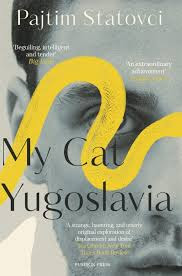
My Cat Yugoslavia (Finnish 2014, English Translation 2017) By Pajtim Statovci


My Cat Yugoslavia is an amazing and strange book. While not particularly an easy read, it is an excellent read.

The author Pajtim Statovci is a now 30-years old war refugee, born in Kosovo, living in Finland.  My Cat Yugoslavia, his first novel, is semi-autobiographical. He’s written two other novels, Crossing and Bolla, all three have won literary awards. 

How does one begin to talk about this book? 

Let’s start with the two main narrators: Emine, a girl first introduced to the reader as a teenager; and then leaping ahead twenty-some years, her son Bekim. Their lives are as complex as Yugoslavian history. 

They are ethnic Albanians from a village outside Pristina, the provincial seat of Kosovo, then a part of the Republic of Serbia, which became a part of Yugoslavia – a nation “created” from “leftover countries” by mapmakers in the aftermath of World War I (Paris 1919, Six Months That Changed the World by Margaret MacMillan). Yugoslavia contained three ethnic groups, and several erstwhile Republics.  By the end of World War II it had evolved into a communist country held together by Prime Minister, then dictator, Josip Tito. The book begins at the time of Tito’s death, which lead to multiple wars including the war between Serbia and Bosnia, the politics of which is well beyond my ability to simplify.

While still a teen, Emine is married off to a man from a neighboring village, who turns out to be abusive to her and their children. When the war breaks out the family flees Kosovo, eventually becoming refugees living in Finland. There are multiple topics crafted together in this novel: the issue of war refugees, the treatment of immigrants, the generational divide between immigrant parents raised in the old country and their children raised in the new country, abusive family relationships, and the impact all of this has on one’s ability to navigate one’s own life. 

With that as an overview, let me explain why I used “strange” to describe the novel.  There are other characters who play a role in the book: Bekim’s pet boa constrictor; and “The Cat,” a human with a cat persona that Bekim picked up in a gay bar and who became his first live-in relationship -- the cat and the snake do not like each other; and finally, a real cat who Bekim befriends near the end of the book while visiting the village where he was born back in Kosovo. 

Three or four chapters into reading My Cat Yugoslavia I was so confused I had to stop and start over. A helpful hint from my friend Daniel who sent me the book, clued me in that my difficulty was discerning when, from chapter to chapter, the first person narrator changed, which was frequently, as did the year and place the action was occurring. Forewarned, on the second go around I had little difficulty.   

Recommendation:  Highly recommended. This will definitely be a re-read in a few months after I’ve had time to digest it.


Friday, October 30, 2020

The Man Who Planted Trees (1954) By Jean Giono


A couple of months ago I blogged about the descriptive mastery of French author Jean Giono in his novel The Horseman on the Roof. Problem was the topic of that book was a cholera pandemic. I believe I used the word “ghastly.” I wondered then about applying his descriptive powers to other, more pleasant topics. With that in mind, I picked up a short story of his that is right out of the naturalist genre: The Man Who Planted Trees.

The story is similar to the American folklore classic Johnny Appleseed. Though, instead of planting fruit trees for a growing nation, Giono’s story is about replanting oak forests in the Provence region of SE France in the foothills of the Alps Mountains. The protagonist is a shepherd who after the death of his wife takes on as a personal mission the task of planting a hundred acorns each day in areas abandoned by early settlers who had harvested and destroyed the natural environment which enticed them to settle there in the first place. This book answers my question about utilizing Giono’s writing skills on a more pleasant topic.  He was the perfect writer for The Man Who Planted Trees.

Animated Film Adaptation

In 1988 an animated film adaptation of the book was released. The 30-minute film won the Academy Award for Best Short Story.

Recommendation:  Yes, both book and film are booster shots for humanity, there is yet hope for planet Earth. 


Monday, September 28, 2020

This Blinding Absence of Light (French 2001, English translation 2002) By Tahar Ben Jelloun


In 1972 a military coup against King Hassan II of Morocco failed.  The military officers who organized the attempted coup were executed.  The soldiers who were just following the orders of their commanding officers when they forced their way into the King’s palace, were tried and sentenced to prison.  Author Tahar Ben Jelloun tells of their plight in his award-winning novel This Blinding Absence of Light.

The soldier-prisoners were hooded and taken from their cells and thrown into a back of a truck which sped off into the night – they thought to certain death.  No notice was given, no family member was informed, no records were kept, they just disappeared.  They had been transported to Tazmamart, a secret facility for political prisoners in the Atlas Mountains in the southeast of the country.  They were surprised that they were not killed, but soon realized their punishment was worse.  Each was put in a solitary cell, with ceilings so low they could not stand, and without windows or any other source of light.  They could die, and most did, but they would not be killed. 

The book is narrated by a prisoner named Salim, and as hard as it may be to believe, it is not entirely depressing.  It is a story of the personal mechanics of survival, including working out a communications network with neighboring cells, and is steeped in faith and philosophy.  It is in fact a compelling read (and even includes several incredibly funny passages (i.e. the telling of A Streetcar Named Desire).  

Through negotiations with the guards – who like them were merely following orders -- they were finally able to establish minimal contact with the outside world.  Through one such contact they were able to get word to Amnesty International of their existence in this secret gulag.  Years later they would be freed as a result of international pressure on the government of Morocco.  One released prisoner eventually managed to get smuggled out of the country to France where he met and told the story to Ben Jelloun.

While that story outlines the cruelty mankind is capable of, and you know how it’s going to end, and you also know it isn’t going to be pretty, you keep reading it because of Salim’s wise and unfathomably good heart.

Recommendation:  Great Read

I’ve blogged two other books by Ben Jelloun, A Palace in the Old Village and Leaving Tangier,  both were excellent.

Saturday, August 29, 2020

The Horseman on the Roof (French 1951, English 1953) By Jean Giono


Jean Giono is considered one of France’s greatest writers.  His mastery of narrative description is remarkable.  If the topic is beauty, valor or honor, the reader is sure to be enthralled. There is a downside to this skill however, and it is on shocking display in Giono’s classic The Horseman on the Roof: the story is set in the southeast of France during a cholera outbreak.  The visual of the narrative is ghastly, page after page of real life and death brought to your eyes and nose.  That said, it is a compelling read.

The story is about a young Italian man named Angelo Pardi.  He is a cavalry officer and a gentleman, son of nobility, elitist, yet fighter for revolution.  There is a lot of contradiction in that sentence, which makes Angelo an interesting character.  He has had to flee to France where he works to organize other exiles and let them know they’ve been sold out by the latest alliance change among Europe’s endlessly warring states.  It is France’s post-Napoleon era. 

Angelo's flight to France soon becomes a nightmare as the cholera epidemic begins to spread from person to person, village to village. The horror of the epidemic, with people trying to survive, and turning on each other, blockades at city gates, and mandatory communal quarantines of out-of-towners – is impeding Angelo’s work.  At one point, to avoid capture he ends up crawling on the tiled rooftops of a village – hence the title of the book.  In his escapades, he meets a young French noblewoman, who herself is trying to survive.  They will travel together, ever eastward trying to stay one step ahead of both the epidemic, and the French military.

In 1995, a movie based on book was released starring Olivier Martinez  as Angelo, and Juliette Binoche as Pauline, the noblewoman.  It is largely faithful to the script – which makes its cholera scenes a bit much.  I prejudged the movie assuming it would be your typical “beautiful people” among the world’s ugliness re-write.  I was wrong on that front. There are many political asides in the book that are lost on readers without a background in French history (like me). The movie does a fairly good job of explaining this history for an international audience. 

Recommended.  Yes, both book and movie.  Though, not for the squeamish.


Thursday, August 27, 2020

The Edible Woman (1969) By Margaret Atwood


The Edible Woman was Margaret Atwood’s first book.  Published in 1969 it has been categorized as belonging in almost every literary genre one can list. For me, I’ll call it feminist, though from reading interviews of Atwood I’m not sure she would completely agree.

The lead character is a young woman living in Toronto.  Her name is Marian.  She works for a marketing firm writing survey questionnaires.    

Marian is single.  Early in the book she will become engaged to her boyfriend Peter because that is the expected next step in her life.  Peter is what would have been called at the time “a good catch,” a handsome, up-and-coming professional. He, without a clue, treats her as nothing more than an accessory in his professional advancement. Peter though clearly a schmuck, is not necessarily an evil one. Her realization of this is the main plot of the book.

Ainsley is Marian’s roommate.  They have little in common.  Marian’s character is buying into what is supposed to be “a woman’s role” in society. Ainsley is having none of that.  Ainsley’s subplot is her decision to have a baby, without a husband.  She picks out an old friend of Marian’s to be the father, then waits until her pregnancy is confirmed before telling him his role is complete; he is no longer needed.

Then there is Duncan, without competition the most bizarre character in the story.  For most of the book he is referred to as “the laundromat guy.”  From scene to scene he is either a very insecure geek, or a complete jerk … sometimes both.  Duncan, and his two roommates, are English Literature Masters students – and Atwood’s depiction of the trio is priceless, not to mention spot on.  Through Duncan, Marian will realize she needs to bail from her “a woman’s role” trajectory.

Throughout the story, Marion develops increasingly severe eating disorders, all stress related.  How she deals with these is the source of the book’s title and makes for a hilarious conclusion.

Recommendation:  Highly recommended